March 2025 · 10 min read
How Internal Approval Dynamics Quietly Distort Corporate Gift Box Type Selection
There is a structural problem in how most New Zealand organisations select the type of corporate gift box for their programmes, and it has nothing to do with the quality of the options available or the competence of the procurement team managing the process. The problem sits in the approval chain itself — specifically, in the gap between the person who signs off on the gift type and the people who will actually receive it. This gap is not a failure of communication. It is a feature of how corporate purchasing decisions are structured, and it produces a predictable pattern: gift types that look impressive in the approval meeting but underperform when they reach the desks, mailboxes, and homes of the intended recipients.
The dynamic works like this. A gifting programme is initiated — perhaps for year-end client appreciation, a staff milestone, or a conference welcome package. The procurement coordinator or executive assistant assembles options, typically requesting samples from one or two suppliers. Those samples are presented to a senior decision-maker: a marketing director, a CEO, or occasionally a CFO who holds the budget. That person opens one box, in a boardroom, under conditions that bear no resemblance to how the gift will actually be received. They assess it through their own lens — does it look premium enough for our brand? Does the packaging reflect our values? Is the cost justifiable? — and the type is approved or rejected on that basis. At no point in this process does anyone systematically consider how the gift type will be experienced by the actual recipient population, which may include people with entirely different expectations, contexts, and needs.
In practice, this is often where corporate gift box type decisions start to be misjudged. The approver is evaluating a single, perfectly assembled sample under ideal conditions. The recipient will open the same type of box at their desk between meetings, or at home after a long day, or in a shared office where the unboxing is semi-public. The context changes everything about how the gift type is perceived. A premium food and wine gift box that impresses a CEO in a boardroom may create awkwardness for a junior account manager who receives it at a hot-desking station with no fridge. A branded merchandise set that signals corporate identity to a marketing director may feel impersonal to a long-standing client who expected something that acknowledged the relationship rather than the brand. The type was selected to satisfy the approver's criteria, not the recipient's reality.

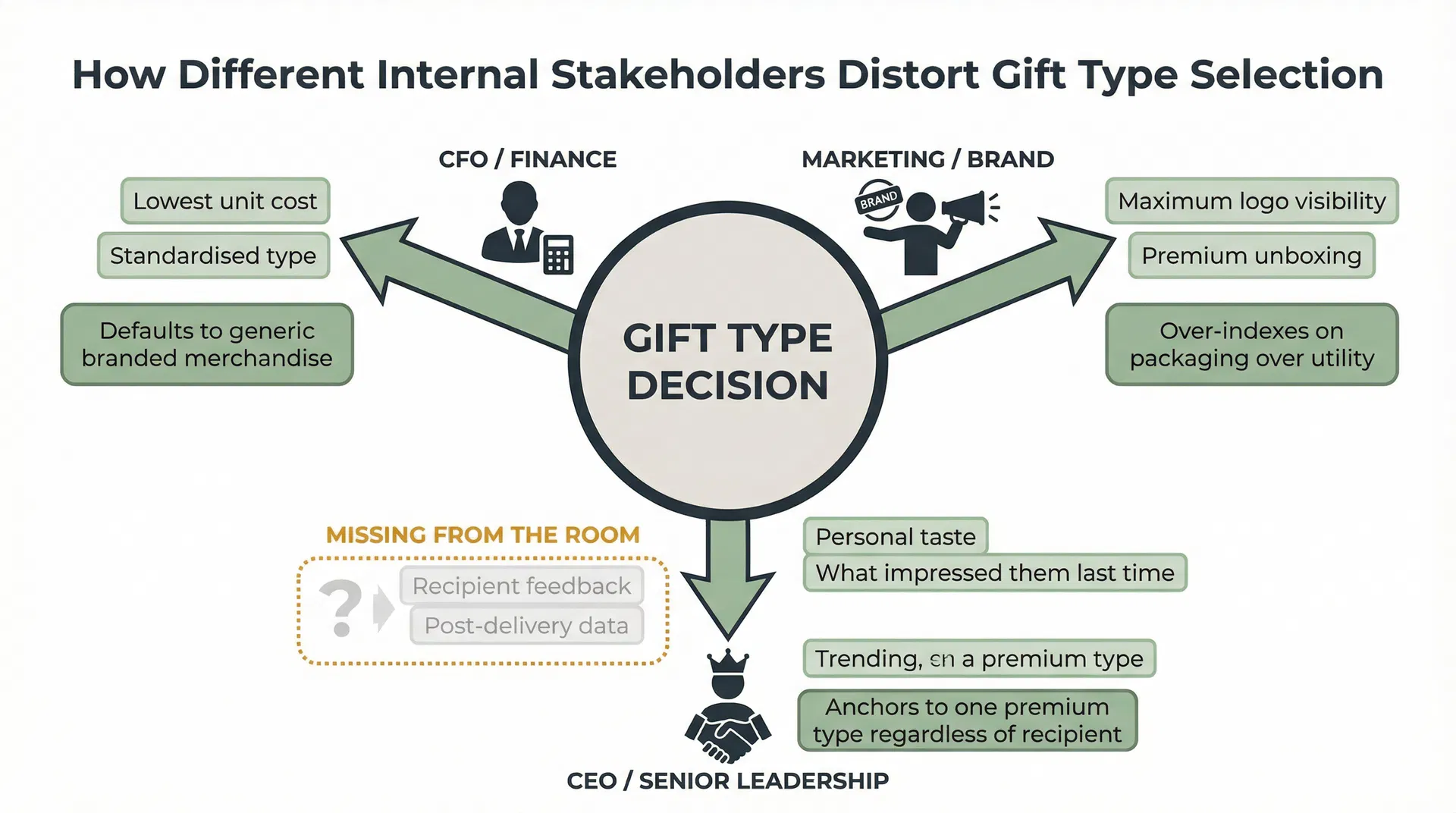
The distortion becomes more pronounced when multiple internal stakeholders are involved in the approval, which is common in mid-to-large New Zealand organisations. Each stakeholder brings a different priority to the table, and the gift type that emerges from the approval process is often a compromise that serves none of those priorities particularly well. The finance team pushes for the lowest per-unit cost, which biases the selection toward standardised branded merchandise — functional, predictable, and easy to justify in a spreadsheet. The marketing team advocates for maximum brand visibility, which biases toward items with prominent logo placement and premium unboxing experiences that photograph well for internal communications. Senior leadership, meanwhile, tends to anchor on personal taste or on whatever gift type impressed them at a recent event, which introduces a recency bias that has nothing to do with the current programme's objectives. The resulting selection is a type that is cost-acceptable, brand-visible, and leadership-endorsed — but potentially misaligned with the actual business need the gifting programme was designed to serve.
What compounds this is the absence of recipient feedback in the approval loop. In almost every other area of corporate spending — marketing campaigns, employee benefits, client services — there is some mechanism for measuring whether the investment achieved its intended outcome. In corporate gifting, the feedback loop is almost entirely absent. The programme is approved, the gifts are delivered, and the organisation moves on. If the gift type was wrong — if the curated food box sat unopened because half the recipients had dietary restrictions that nobody checked, if the branded notebook set was redundant because the recipient already had three from other suppliers — that information rarely makes it back to the person who approved the type. The same type gets reordered the following year, not because it performed well, but because nobody has evidence that it did not.
There is a specific version of this problem that is particularly common in New Zealand's corporate gifting context. The country's business culture places a high value on practicality and authenticity — gifts that feel genuine and useful tend to resonate more strongly than gifts that feel performative or extravagant. But the internal approval process often selects for the opposite qualities. An approver looking at two sample boxes side by side will almost always gravitate toward the one that looks more impressive on the table — the one with the heavier packaging, the more elaborate presentation, the higher perceived value. This is a natural human response, but it creates a systematic bias toward gift types that prioritise visual impact over practical utility. The recipient who opens that impressive box and finds a set of items they will never use does not share the approver's assessment. They experience the gap between presentation and substance, and that gap quietly undermines the relationship the gift was meant to strengthen.
The compliance dimension adds another layer that most approval processes overlook entirely. When an organisation selects a gift type, the approver considers their own company's gifting policy — the budget ceiling, the branding guidelines, the procurement protocols. What they almost never consider is the recipient organisation's policy. Many New Zealand corporates, government agencies, and publicly listed companies have strict limits on the value of gifts their staff can accept, and some prohibit certain categories altogether. A premium gift box valued above a recipient's acceptance threshold does not just fail to achieve its objective — it creates an active problem. The recipient must either decline the gift, report it through their compliance process, or accept it with discomfort. None of these outcomes serve the relationship. The gift type was compliant from the sender's perspective but non-compliant from the receiver's, and this asymmetry is invisible in the standard approval process because nobody in the room is checking the other side's rules.
The repeat-year problem amplifies all of these dynamics. Organisations that run annual gifting programmes — Christmas gifts for clients, end-of-financial-year recognition for staff — tend to lock in a gift type in year one and repeat it indefinitely. The original approval decision, with all its inherent biases, becomes the default. Nobody re-evaluates whether the type is still appropriate as the recipient pool changes, as relationships evolve, or as the business context shifts. A welcome gift type that was suitable for a new client relationship in year one is not necessarily the right type for a mature partnership in year three. A staff appreciation gift that resonated with a team of twenty may not translate to a department of eighty after a merger. But because the type was "approved" — past tense — it continues without scrutiny, and the approval bias from the original decision compounds year over year.
The practical consequence of all this is that many corporate gifting programmes in New Zealand are optimised for internal approval rather than external impact. The gift type satisfies the boardroom but underdelivers at the point of receipt. This is not because the available gift types are inadequate — there is a genuinely broad range of corporate gift box options suited to different business contexts — but because the selection mechanism is structurally biased toward the approver's perspective rather than the recipient's experience. The fix is not complicated in principle, though it requires a deliberate change in how the approval process is structured. It means introducing recipient-side data into the decision — even something as simple as a post-delivery survey from the previous year's programme, or a brief review of the recipient organisations' gifting policies before type selection begins.
It also means recognising that the sample approval stage is not a reliable predictor of programme performance. A sample is a single unit, opened by a person who chose it, in a setting designed to showcase it. The production run is hundreds of units, opened by people who did not choose them, in settings that range from corporate offices to home kitchens to shared workspaces. The gift type that performs well under the first set of conditions may not perform well under the second, and the only way to know is to build feedback mechanisms that close the loop between delivery and the next approval cycle. Without that feedback, the approval bias persists — not because anyone intends it, but because the structure of the decision process makes it inevitable.
Organisations that manage this well tend to separate the approval of the gift type from the approval of the gift budget. The budget decision belongs to finance. The type decision belongs to whoever has the closest understanding of the recipient population — which is often the account management team for client gifts, or the HR team for staff recognition. When these two decisions are collapsed into a single approval meeting dominated by a senior executive's personal preference, the type selection is almost guaranteed to reflect the approver's taste rather than the programme's purpose. The distinction matters because the right type of corporate gift box is not the one that looks best on the boardroom table. It is the one that achieves the intended outcome — strengthening a relationship, acknowledging a contribution, marking a milestone — in the hands of the person who actually receives it.