March 2025 · 13 min read
Why Your Corporate Gift Box Type Has Not Changed in Three Years and Why That Is a Problem
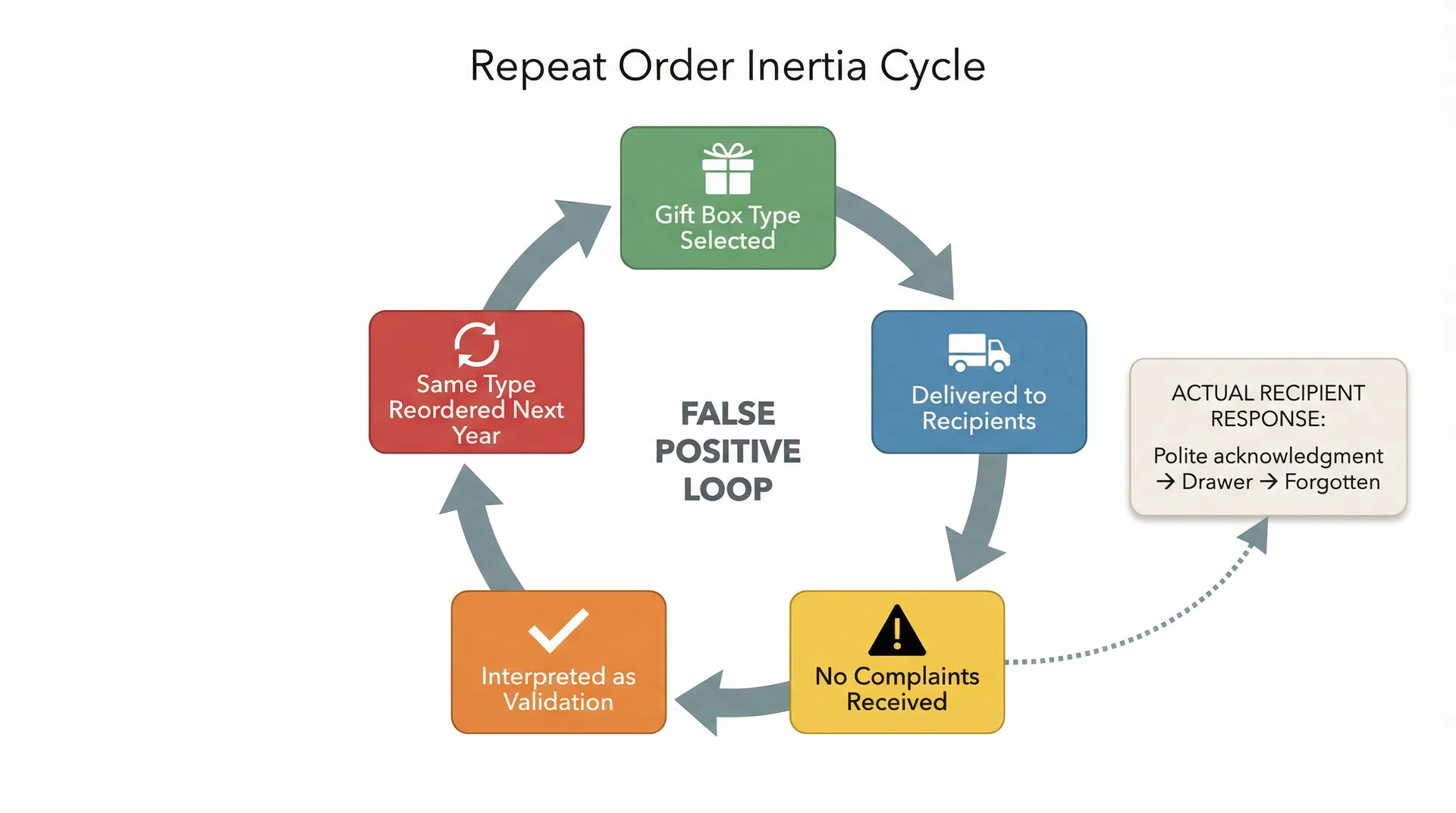
From the production side, there is a pattern we see with uncomfortable regularity. A corporate client places an order for a particular gift box type — say, a curated food and beverage selection with branded sleeve packaging. The order goes well. The client is satisfied. Twelve months later, the same purchase order comes through with near-identical specifications. The quantities might shift slightly, the delivery address list gets updated, perhaps one product is swapped because a supplier discontinued a line. But the fundamental type decision — what kind of gift box this is, what it contains in structural terms, what it is designed to achieve — has not been revisited. This happens again the following year. And the year after that. We have clients whose gift box type specifications have not meaningfully changed in four or five consecutive ordering cycles. The brief that arrives each year is not a brief at all. It is last year's purchase order with a new date.
In practice, this is often where corporate gift box type decisions stop being decisions at all and become administrative repetitions. The procurement team is not actively choosing this type of gift box each year. They are choosing not to reopen the question. And the reason they are choosing not to reopen it is that they have received no signal — from recipients, from management, from anyone — that the current type is wrong. The absence of complaints has been interpreted as evidence that the type is correct. This interpretation is almost always mistaken, but it is also entirely rational given the information available to the procurement team. Nobody has told them the gift was ineffective. Nobody has told them the recipients found it predictable. Nobody has told them that the same artisan cracker and chutney combination that felt fresh and thoughtful in year one now feels like a standing order that arrives on autopilot. The feedback mechanism that would surface these signals simply does not exist in most corporate gifting programmes.
What we observe from the factory floor is the operational consequence of this inertia. When a client reorders the same gift box type without specification changes, the production process becomes frictionless. We know the components, we know the assembly sequence, we know the packaging dimensions, we know the supplier lead times. There is no prototyping phase, no sample approval cycle, no back-and-forth on material choices. The order moves straight from confirmation to production. This efficiency is genuine and it saves the client time and cost. But it also means that the one moment in the annual cycle when the gift box type might have been questioned — the specification and sampling phase — has been eliminated. The client has optimised away the decision point. They have made the process faster by removing the step where someone might have asked whether this type of corporate gift box is still the right one for what the business is trying to accomplish.
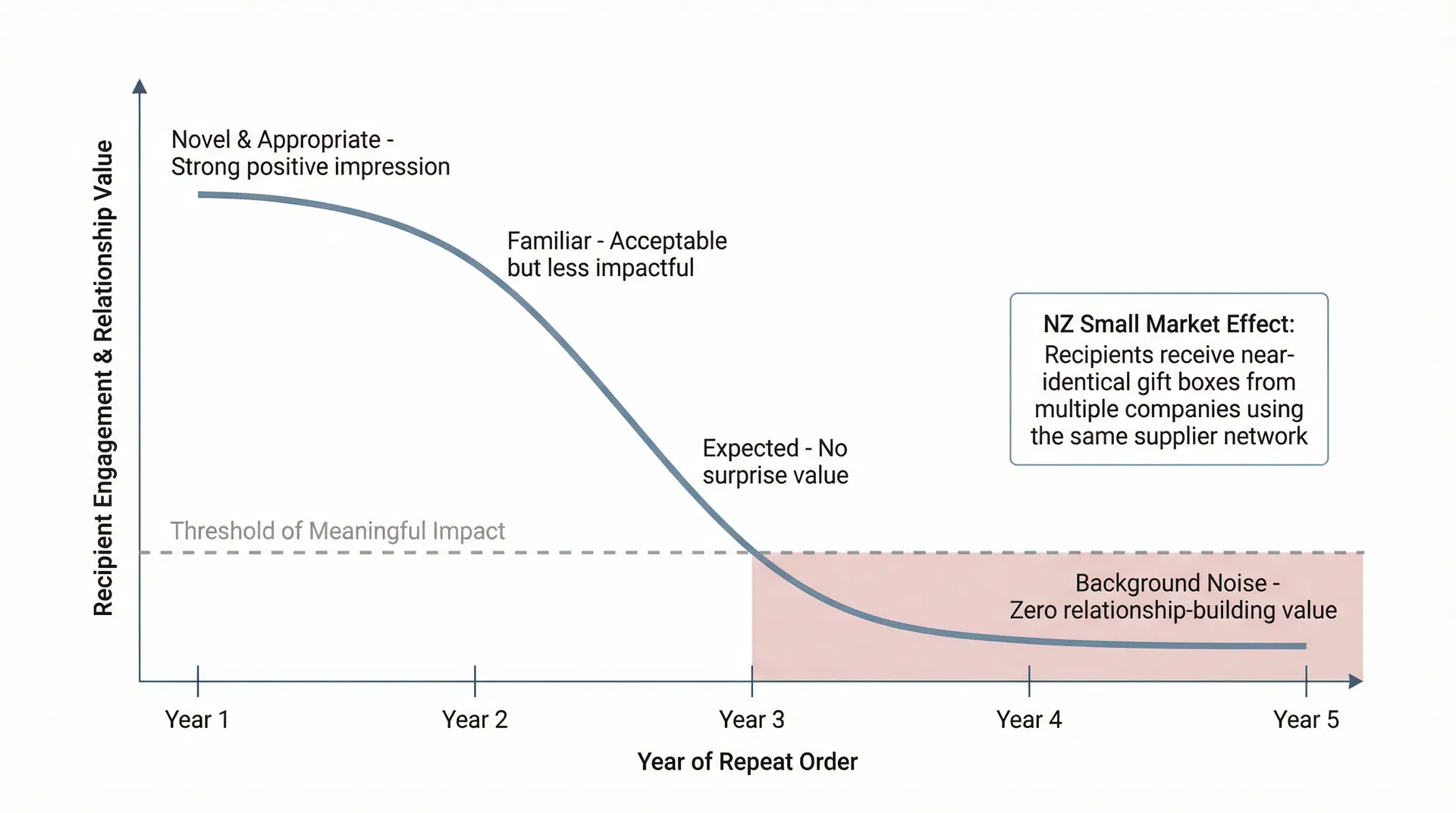
The compounding nature of this problem is what makes it worth examining closely. A gift box type that is genuinely well-matched to the business need and the recipient context will produce a strong positive impression in its first year. The novelty of the gift, the quality of the curation, the thoughtfulness of the selection — all of these factors contribute to an impact that goes beyond the material value of the contents. In the second year, the same type still performs adequately. The recipient recognises the quality and appreciates the consistency. But the novelty component has been removed. The gift is no longer a pleasant surprise; it is an expected delivery. By the third year, the gift box has become part of the background rhythm of the corporate relationship. It arrives, it is acknowledged, it is consumed or stored, and it generates no particular emotional response in either direction. The recipient does not dislike it. They simply do not notice it in any meaningful way. The gift has crossed the threshold from relationship-building gesture to administrative routine, and the procurement team has no way of knowing this has happened because the external signals — the thank-you emails, the absence of complaints — remain exactly the same.
There is a dimension of this problem that is particularly acute in the New Zealand market, and it relates to the concentrated nature of the supplier network. New Zealand's corporate gift box industry draws from a relatively small pool of local artisan producers, food manufacturers, and packaging suppliers. When multiple corporate clients order the same general type of gift box — the premium New Zealand food selection is the most common example — the resulting products share a significant overlap in their actual contents. The Marlborough sauvignon blanc, the Central Otago honey, the Hawke's Bay olive oil, the Canterbury craft chocolate — these products appear across gift boxes from different suppliers because the source pool is finite. A senior executive at a mid-size Auckland firm who receives corporate gift boxes from three or four business relationships each year may open three or four boxes that contain substantially similar products, sourced from the same regions, presented in similar kraft or recycled packaging. The gift box type that the procurement team selected because it felt distinctly New Zealand and premium now looks indistinguishable from every other corporate gift the recipient has received that quarter. The type decision that felt safe and appropriate has, through no fault of the individual procurement team, produced a gift that is invisible.
This convergence effect accelerates the diminishing returns of repeat ordering. If the gift box type were unique to the gifting organisation — if it contained products or a curation approach that recipients could not receive from any other source — then repeating the same type would carry less risk. The gift would still be familiar, but it would be exclusively associated with the gifting relationship. In New Zealand's small market, that exclusivity is difficult to achieve with the most commonly ordered gift box types. The food and beverage selection box, the premium hamper, the branded merchandise collection — these are the types that every corporate gifting supplier offers because they are the types that every procurement team requests. The result is a market-wide convergence toward a narrow band of gift box types that are individually adequate but collectively redundant. The procurement team's decision to reorder the same type is not just a repetition within their own gifting programme; it is a repetition within the recipient's entire experience of corporate gifting from all sources.
From a project management perspective, the operational incentives all point toward maintaining the current type. Reordering is fast, predictable, and low-risk. Introducing a new gift box type requires a full specification cycle: identifying the business objective, briefing the supplier, reviewing samples, gaining internal approval, managing the transition from the previous type. This process takes weeks and involves multiple stakeholders. For a procurement team managing dozens of vendor relationships and hundreds of line items, the corporate gift box is rarely the category that warrants that level of reinvestment. It is easier — and in the short term, genuinely more efficient — to reorder. The problem is that this short-term efficiency creates a long-term effectiveness gap. The gift box programme continues to consume budget, continues to generate logistics activity, continues to produce thank-you emails, but the actual relationship-building value it delivers has been declining steadily for years. The programme is running, but it is no longer working.
What makes this pattern particularly resistant to correction is that the evidence of failure looks identical to the evidence of success. A gift box type that is genuinely well-received and a gift box type that is politely tolerated produce the same observable outcomes from the procurement team's vantage point. Both generate acknowledgment from recipients. Both avoid complaints. Both are delivered on time and within budget. The only difference is in the quality of the recipient's internal response — whether the gift created a genuine moment of connection or merely fulfilled an expected transaction — and that difference is invisible to everyone except the recipient, who has no channel and no incentive to communicate it. The procurement team is making rational decisions based on the available data. The available data is simply incomplete in a way that systematically favours inertia.
There is a practical test that occasionally surfaces this problem, and it is worth noting because it illustrates the gap between perceived and actual performance. When a company changes its gift box type — not because the previous type failed, but because a new procurement lead arrives, or a supplier relationship changes, or a budget restructure forces a reassessment — the reaction from recipients sometimes reveals what the previous type was actually achieving. If recipients notice the change and comment positively on the new type, it suggests the previous type had become invisible and the change itself created value through novelty. If recipients notice the change and express disappointment, it suggests the previous type had genuine resonance. If recipients do not notice the change at all, it confirms that the gift box had long since crossed into background noise territory. In our experience assembling corporate gift boxes for New Zealand businesses, the third outcome is by far the most common. The type change goes unnoticed because the previous type had already stopped registering with recipients years before the change was made. The programme had been spending budget on a gift that was functionally invisible, and the repeat ordering cycle had prevented anyone from discovering this.
The structural solution is not to change the gift box type every year for the sake of change — that would create its own problems with supplier relationships, cost predictability, and brand consistency. The solution is to build a deliberate review point into the annual ordering cycle that requires the procurement team to actively reaffirm the type decision rather than passively repeat it. This means reinstating the specification and sampling phase that repeat ordering eliminates. It means asking the supplier whether the market has shifted, whether new product categories have emerged, whether the type that was appropriate three years ago still represents the strongest option for the stated business need. It means, at minimum, acknowledging that understanding which types of corporate gifts serve different business needs is not a one-time decision but an ongoing evaluation that should be revisited as both the business context and the recipient landscape evolve.
The most effective corporate gift box programmes we see from the production side are the ones that treat the type decision as a live question rather than a settled one. They do not necessarily change the type every year, but they go through the process of confirming it is still the right type every year. They request updated samples. They ask whether the recipient population has changed. They consider whether the business objective the gift is supposed to serve has shifted. This annual revalidation adds a modest amount of time and cost to the procurement cycle, but it prevents the slow, invisible degradation that repeat ordering produces. It is the difference between a gifting programme that is actively managed and one that is simply running on autopilot — and from where we sit on the production floor, watching the same specifications come through year after year with no questions asked, the distinction matters more than most procurement teams realise.